01
MAINTENANCE
Your questions about electric gate servicing answered, from how often to book a service to what to look for in a service provider.
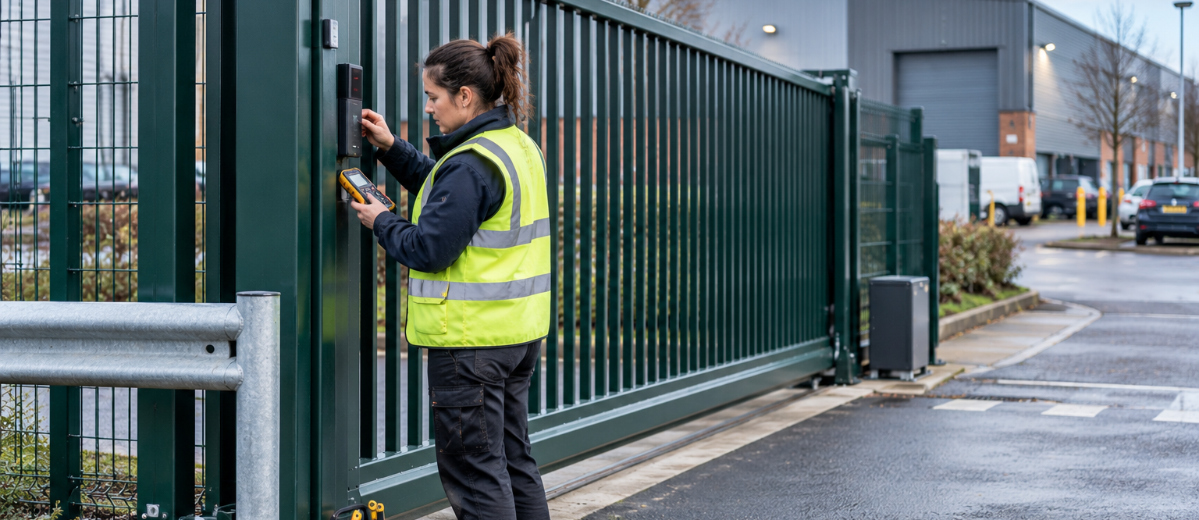
Electric gates contain moving, electrical and safety components that are used every time the gate opens or closes. Naturally, over time, parts can wear out, settings can change, and dirt, weather, or accidental damage can affect how the system operates.
Regular servicing can help identify these issues before they lead to a breakdown or pose a safety risk, and can also help keep the gate operating smoothly and reduce the risk of avoidable repairs and disruption.
When it comes to how often an electric gate should be serviced, it depends on a variety of factors. A swing gate at a private home may have very different maintenance requirements from one controlling access to a busy commercial yard.
Read on to learn how often your electric gates should be serviced, what that should include and why your gate may need attention sooner.
An electric gate is a piece of powered machinery with motors, hinges, rollers, tracks, control equipment and safety devices that all need to work together correctly for the gate to operate safely.
Regular servicing and maintenance give a competent engineer an opportunity to check the condition and operation of the complete system. Worn or damaged components can be identified, safety devices can be tested and adjustments can be made where required to avoid any potential or real problems.
This is important even when the gate appears to be working normally. Wear can develop gradually, and problems with safety equipment may not always be obvious during everyday use.
Servicing can also help with reliability. Finding a worn roller, a loose-fitting one, or a developing motor problem during a planned visit may be less disruptive than dealing with a gate that suddenly stops working at an inconvenient moment, leaving your entrance unsecured.
The appropriate schedule should take into account the gate manufacturer’s instructions, the type of automation, the operating environment and how frequently the entrance is used.
As a general guide:
Lower-use residential gates: A service every six to twelve months may be appropriate, depending on the manufacturer’s recommendations, system and conditions. Six-monthly servicing provides a more regular opportunity to identify wear and safety issues.
Frequently used residential or shared gates: Consider servicing approximately every six months, particularly where several households, vehicles or regular visitors use the entrance.
Commercial gates with regular daily traffic: Six-monthly servicing can provide a useful baseline, although the maintenance schedule should be based on the site’s risk assessment, manufacturer guidance and level of use.
High-use commercial and industrial gates: Gates operating many times each day may need attention more frequently. In some cases, a competent maintenance provider may recommend quarterly visits or servicing based on the number of operating cycles rather than a fixed calendar interval.
Other factors can affect the servicing schedule, such as the environment and location. A gate exposed to coastal conditions, heavy rain, strong winds, dirt or debris may require closer attention than a comparable gate in a more sheltered location.
Electric gates at private homes usually operate less frequently than those at commercial premises, but that doesn’t mean maintenance should be overlooked.
A residential gate may still open and close several times each day as household members leave, return home and receive visitors or deliveries. Moving components gradually wear, while weather and debris can also affect tracks, photocells and other parts of the system.
Although domestic properties with privately owned electric gates don’t fall under health and safety laws, HSE strongly recommends that domestic gates are regularly checked by a competent specialist with the knowledge required to carry out the necessary testing.
If you’ve moved into a property that came with an automated gate and don’t know its maintenance history, arranging an inspection can help establish its condition and an appropriate servicing schedule.
Commercial gates can have much higher operating demands and, therefore, require more routine servicing.
A gate controlling a warehouse, office car park, industrial site or residential development might operate repeatedly throughout the working day as staff, visitors, contractors and delivery vehicles come and go.
This increased use can accelerate wear on motors, rollers, hinges and other mechanical components. It also makes reliable safety equipment particularly important because more people may regularly encounter the gate.
Six-monthly professional servicing is commonly recommended as a starting point for powered gates, but a particularly busy entrance may require more frequent inspections and maintenance.
Businesses and organisations that have automated gates are legally responsible for keeping them and their users safe.
The HSE states that owners and occupiers of commercial premises with powered gates have duties under the Workplace (Health, Safety and Welfare) Regulations 1992. Regulation 5 covers maintenance, while Regulation 18 deals with doors and gates and their safe operation.
Duties under the Health and Safety at Work etc. Act 1974 may also apply where a gate could affect people who aren’t employees, such as visitors or members of the public.
Similar responsibilities can also apply to landlords and managing agents responsible for gates in communal residential developments.
Importantly, the law doesn’t simply set one servicing interval that makes every commercial gate compliant. The HSE advises that inspection frequency should reflect the gate type, how it’s used, the conditions it’s exposed to, the manufacturer’s recommendations and the relevant risk assessment.
Commercial gate owners and site managers should therefore ensure that all gates are regularly inspected and maintained (including any safety equipment) by someone competent in the activity.
Any problems that could or are affecting safety should be recorded and addressed promptly, with the appropriate maintenance and testing records being retained.
If a powered gate is found to be dangerous, the HSE advises that it should be taken out of use until the safety concerns have been properly addressed.
You don’t need to wait until the next planned service if the way your gate operates changes.
Some problems are minor at first but can become more serious if ignored, and others can arise suddenly, such as damage from extreme weather. Signs that your electric gate may need to be inspected sooner rather than later include:
Unusual noises, such as grinding, scraping, clicking or squeaking
Slower opening or closing than normal
Jerky or uneven movement
A sliding gate is beginning to drag or move poorly along its track
A swing gate sagging or no longer sitting correctly
The gate stops before it reaches its normal open/closed position
Unreliable remotes, keypads or other controls
Photocells or other safety devices behaving unexpectedly
Visible damage, corrosion or loose components
Fluid leaking from hydraulic equipment
Increasing difficulty operating the manual release
Problems with safety equipment should be treated particularly seriously – do not bypass a photocell, safety edge or another protective device to keep the gate operating.
The exact work required during a service will depend on the gate, automation and access-control equipment installed. A thorough service should consider the entire gate, not just checking whether the motor opens and closes it.
This may include checking:
The gate structure, posts and supporting components
Hinges, rollers, tracks, brackets and other moving parts
Motors, operators and drive mechanisms
Electrical connections and control equipment
Photocells, safety edges and other protective devices
Opening, closing and stopping positions
Manual-release equipment
Access controls such as remotes, keypads and intercom connections
Signs of corrosion, wear or accidental damage
Any problems found during the service should be explained to you clearly, along with any recommended repairs or further work.
For commercial automated gates, maintaining a service and repair record can also provide useful evidence of the steps taken to keep the gate safe. These records could be later used to demonstrate health and safety priorities for certifications.
Electric gate maintenance requires more than general mechanical or electrical experience.
A servicing company should fully understand powered gate systems, their potential hazards and the safety requirements that apply to them. Depending on the installation, this may require knowledge of mechanical, electrical, hydraulic or pneumatic systems, as well as specialist safety-testing equipment.
When choosing a company, you may want to create a checklist of things to look for. This should include having specific experience servicing automated gates, understanding current powered-gate safety requirements, the ability to work on the type of gate and automation system you have, having suitable equipment for any required force testing and leaving the gate in a safe condition following servicing or repairs.
Regular servicing can help keep an electric gate safe and suitable for everyday use. But how frequently it needs attention will depend on the system, its location and the number of times it operates, which is why maintenance schedules should be considered individually.
For homeowners, planned servicing can help identify wear before it develops into a larger problem and you can’t relax at home. For businesses, landlords and site managers, regular inspection and maintenance are also an important part of meeting broader responsibilities for operational safety.
If your electric gate is due a service, you’ve noticed a change in the way it operates or you are unsure when it was last inspected, Electrogate can help. We provide inspection and maintenance services across the UK for a wide range of properties.
Contact us today to discuss your electric gate servicing requirements.
MORE FROM ELECTROGATE

AUTOMATED GATES & BARRIERS
We’ll help assess traffic, security, site and access requirements before recommending the right system.